
CausalWM: Causal Chain-of-Thought Reasoning for Embodied World Model
A 16B embodied world model that makes physical reasoning explicit — predicting optical flow, then 3D pointmaps, then future video, with each step reused as context for the next. Top-1 on the TriWorldBench leaderboard.
Now available on arXiv.
Abstract
Embodied world models learn to predict future physical dynamics from visual observations and control signals, where physical knowledge is implicitly entangled within latent representations. We introduce CausalWM, a 16B embodied world model that performs explicit causal chain-of-thought reasoning before future video prediction. CausalWM organizes useful variables into a reasoning trajectory, allowing the model to progressively capture causal dependencies underlying physical evolution. To train CausalWM, we collect 31K hours embodied data and develop a three-stage paradigm consisting of large-scale video pre-training, causal CoT mid-training, and multi-objective RL post-training. Despite using only a limited set of supervised CoT variables, CausalWM exhibits emergent in-context learning capabilities, enabling contextual visual feature guidance and efficient few-step generation. CausalWM achieves state-of-the-art performance across language-conditioned, action-conditioned, single-view and multi-view benchmarks, including Top-1 performance on TriWorldBench leaderboard.
TL;DR
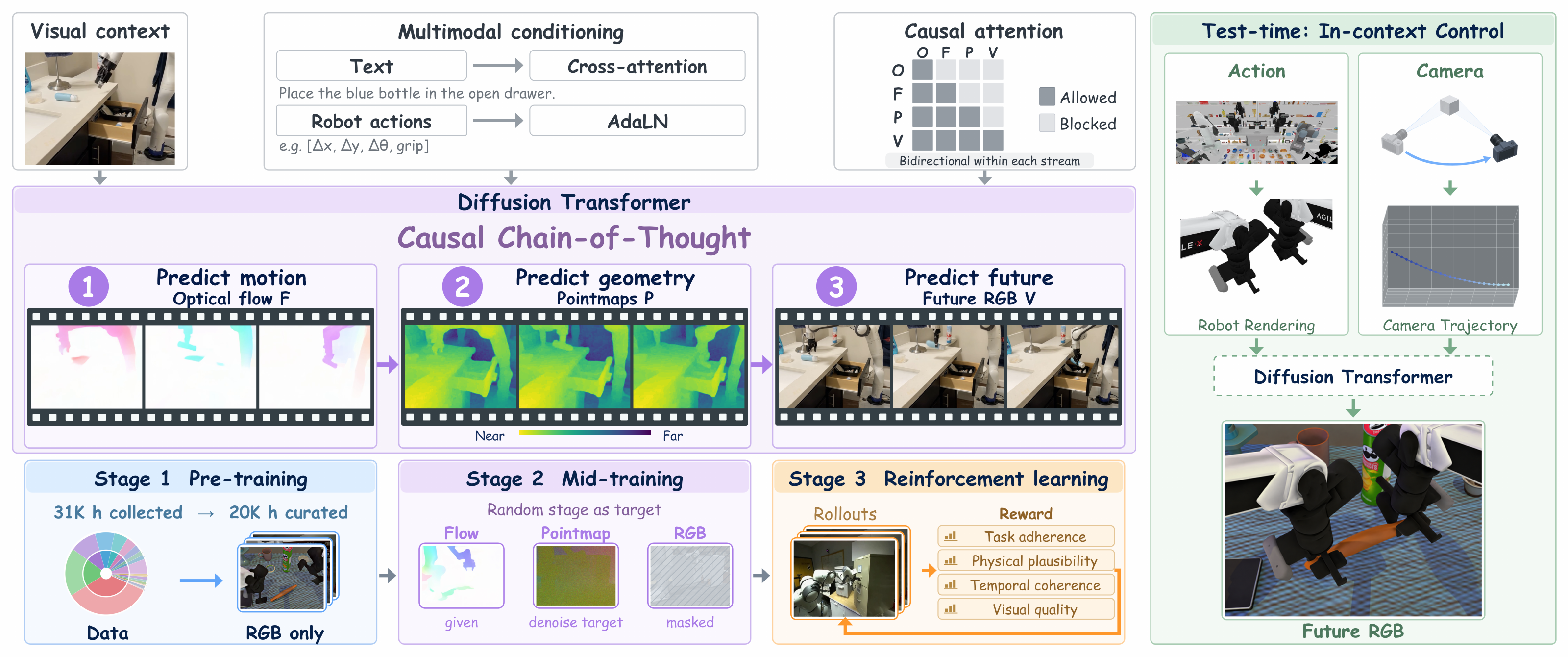
Embodied world models predict future physical dynamics from visual observations and control signals, but their physical knowledge is implicitly entangled in latent representations. CausalWM instead performs explicit causal chain-of-thought reasoning before predicting the future: it predicts optical flow, then 3D pointmaps, then future RGB video — reusing each completed prediction as context for the next (O → F → P → V).
The whole chain runs on one shared diffusion Transformer: causal attention blocks information from later stages from leaking backward, while attention within each stream stays bidirectional. Despite being supervised with only a limited set of CoT variables, the model shows emergent in-context learning — it can even generate the future in one denoising step per stage (3 steps total), at 5.16× the speed of the full 20/20/20 schedule.
Training
A three-stage paradigm on ~31K hours of embodied data (curated to ~20K hours of interaction experience across 20 source families: human egocentric video, real robots, and simulation):
- Large-scale video pre-training
- Causal CoT mid-training
- Multi-objective RL post-training
Results
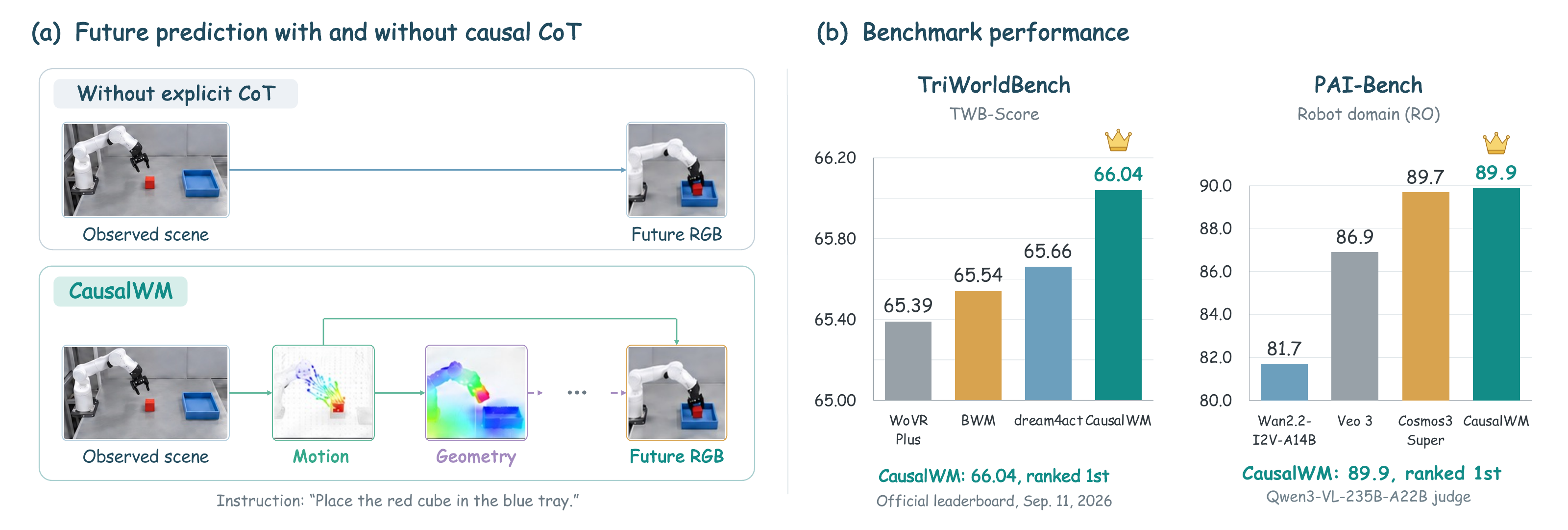
- #1 of 36 models on the TriWorldBench leaderboard (66.04 TWB-Score), with 2 first-place and 5 second-place finishes across the 19 official metrics.
- State-of-the-art 89.9 RO score on the PAI-Bench language-conditioned robot domain.
- Language instructions and robot actions provide complementary ways to steer the imagined future.